InvertedIndex
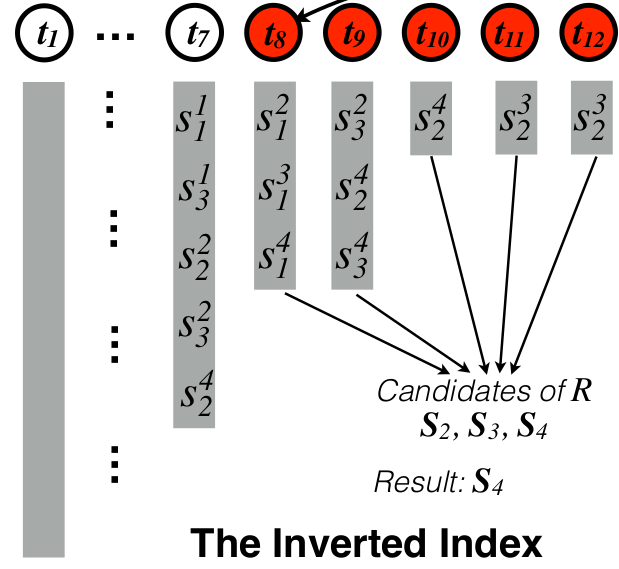
The inverted index
- allows to lookup all appearances of a token in a collection of tokenized sets
- returns inverted lists consisting of (set, element) tuples
- supports full sets/elements and positional indexes of them
- stores source sets in SilkMothEngine
The inverted list
- is sorted first by the order of the sets and then by the order of the elements.
Examples
>>> from silkmoth.inverted_index import InvertedIndex
>>> S1 = [{"Apple", "Pear", "Car"}, {"Apple", "Sun", "Cat"}]
>>> S2 = [{"Apple", "Berlin", "Sun"}, {"Apple"}]
>>> S = [S1, S2]
>>> I = InvertedIndex(S)
>>> I.get_indexes("Sun")
[(0, 1), (1, 0)]
>>> I["Berlin"]
[([{'Sun', 'Apple', 'Berlin'}, {'Apple'}], {'Sun', 'Apple', 'Berlin'})]

SilkMoth Inverted Index. Source: Deng et al., "SILKMOTH: An Efficient Method for Finding Related Sets with Maximum Matching Constraints", VLDB 2017.
Licensed under CC BY-NC-ND 4.0.
Source code in src/silkmoth/inverted_index.py
class InvertedIndex:
"""
The inverted index
- allows to lookup all appearances of a token in a collection of tokenized sets
- returns inverted lists consisting of (set, element) tuples
- supports full sets/elements and positional indexes of them
- stores source sets in [SilkMothEngine](silkmoth_engine.md)
The inverted list
- is sorted first by the order of the sets and then by the order of the elements.
Examples
--------
```
>>> from silkmoth.inverted_index import InvertedIndex
>>> S1 = [{"Apple", "Pear", "Car"}, {"Apple", "Sun", "Cat"}]
>>> S2 = [{"Apple", "Berlin", "Sun"}, {"Apple"}]
>>> S = [S1, S2]
>>> I = InvertedIndex(S)
>>> I.get_indexes("Sun")
[(0, 1), (1, 0)]
>>> I["Berlin"]
[([{'Sun', 'Apple', 'Berlin'}, {'Apple'}], {'Sun', 'Apple', 'Berlin'})]
```
*SilkMoth Inverted Index. Source: Deng et al., "SILKMOTH: An Efficient Method for Finding Related Sets with Maximum Matching Constraints", VLDB 2017.
Licensed under CC BY-NC-ND 4.0.*
"""
def __init__(self, token_sets: list):
"""
Initialize the inverted index.
Args:
token_sets (list): Collection of tokenized sets
sim_func (function): Similarity function
"""
#self.sim_func = sim_func
self.token_sets = []
self.lookup_table = dict()
for set_idx, token_set in enumerate(token_sets):
self.token_sets.append(token_set)
for element_idx, tokens in enumerate(token_set):
for token in tokens:
key = (set_idx, element_idx)
if token not in self.lookup_table:
self.lookup_table[token] = [key]
elif self.lookup_table[token][-1] != key:
self.lookup_table[token].append(key)
def keys(self):
"""
Gives all tokens similar like dict.keys().
Returns:
set (set): A set-like object providing all keys
"""
return self.lookup_table.keys()
def __getitem__(self, token) -> list:
    """
    Access inverted list from inverted index using square brackets.

    Args:
        token (str): Input token

    Returns:
        list:   A list of all (set, element) tuples which contain the input
                token.
    """
    idx_list = self.get_indexes(token)
    return [(self.get_set(s), self.get_set(s)[e]) for s, e in idx_list]
def get_indexes(self, token) -> list:
"""
Access inverted list of indexes. For some tasks retrieving the full set
and element pairs might not be necessary and their indexes are
sufficient.
Args:
token (str): Input token
Returns:
list: A list of all (set index, element index) tuples for (set,
element) tuples which contain the input tuple
"""
if not token in self.lookup_table:
raise ValueError(f"Unknown token")
return self.lookup_table[token]
def get_set(self, set_id: int) -> list:
"""
Access (tokenized) set from set ID.
Args:
set_id: Set ID
Returns:
list: Tokenized set
"""
if set_id < 0 or set_id >= len(self.token_sets):
raise ValueError(f"Invalid id")
return self.token_sets[set_id]
def get_indexes_binary(self, token, set_idx) -> list:
"""
Uses binary search to get all (set_idx, element_idx) pairs for a token
where set_idx matches the given set_idx.
Args:
token (str): The token to search in the inverted index.
set_idx (int): The ID of the set we want the element indexes for.
Returns:
list: All (set_idx, element_idx) tuples where the token appears in the given set.
"""
if token not in self.lookup_table:
raise ValueError("Unknown token")
index_list = self.lookup_table[token]
# Using bisect to find the range of entries where set_idx matches
left = bisect.bisect_left(index_list, (set_idx, -1))
right = bisect.bisect_right(index_list, (set_idx, float('inf')))
return index_list[left:right]
def print_index(self):
"""
Prints the inverted index in a readable format.
"""
print("=== Inverted Index ===")
for token, locations in self.lookup_table.items():
print(f"Token: {token} → Locations: {locations}")
__getitem__(token)
Access inverted list from inverted index using square brackets.
Parameters:
| Name | Type | Description | Default |
|---|---|---|---|
token
|
str
|
Input token |
required |
Returns:
| Name | Type | Description |
|---|---|---|
list |
list
|
A list of all (set, element) tuples which contain the input token. |
Source code in src/silkmoth/inverted_index.py
def __getitem__(self, token) -> list:
"""
Access inverted list from inverted index using square brackets.
Args:
token (str): Input token
Returns:
list: A list of all (set, element) tuples which contain the input
token.
"""
idx_list = self.get_indexes(token)
return [(self.get_set(s), self.get_set(s)[e]) for s, e in idx_list]
__init__(token_sets)
Initialize the inverted index.
Parameters:
| Name | Type | Description | Default |
|---|---|---|---|
token_sets
|
list
|
Collection of tokenized sets |
required |
sim_func
|
function
|
Similarity function |
required |
Source code in src/silkmoth/inverted_index.py
def __init__(self, token_sets: list):
    """
    Initialize the inverted index.

    Args:
        token_sets (list): Collection of tokenized sets
        sim_func (function): Similarity function
    """
    #self.sim_func = sim_func
    self.token_sets = []
    self.lookup_table = dict()

    for set_idx, token_set in enumerate(token_sets):
        self.token_sets.append(token_set)
        for element_idx, tokens in enumerate(token_set):
            for token in tokens:
                key = (set_idx, element_idx)
                if token not in self.lookup_table:
                    self.lookup_table[token] = [key]
                elif self.lookup_table[token][-1] != key:
                    self.lookup_table[token].append(key)
get_indexes(token)
Access inverted list of indexes. For some tasks retrieving the full set and element pairs might not be necessary and their indexes are sufficient.
Parameters:
| Name | Type | Description | Default |
|---|---|---|---|
token
|
str
|
Input token |
required |
Returns:
| Name | Type | Description |
|---|---|---|
list |
list
|
A list of all (set index, element index) tuples for (set, element) tuples which contain the input tuple |
Source code in src/silkmoth/inverted_index.py
def get_indexes(self, token) -> list:
    """
    Access inverted list of indexes. For some tasks retrieving the full set
    and element pairs might not be necessary and their indexes are
    sufficient.

    Args:
        token (str): Input token

    Returns:
        list:   A list of all (set index, element index) tuples for (set,
                element) tuples which contain the input tuple
    """
    if not token in self.lookup_table:
        raise ValueError(f"Unknown token")
    return self.lookup_table[token]
get_indexes_binary(token, set_idx)
Uses binary search to get all (set_idx, element_idx) pairs for a token where set_idx matches the given set_idx.
Parameters:
| Name | Type | Description | Default |
|---|---|---|---|
token
|
str
|
The token to search in the inverted index. |
required |
set_idx
|
int
|
The ID of the set we want the element indexes for. |
required |
Returns:
| Name | Type | Description |
|---|---|---|
list |
list
|
All (set_idx, element_idx) tuples where the token appears in the given set. |
Source code in src/silkmoth/inverted_index.py
def get_indexes_binary(self, token, set_idx) -> list:
    """
    Uses binary search to get all (set_idx, element_idx) pairs for a token
    where set_idx matches the given set_idx.

    Args:
        token (str): The token to search in the inverted index.
        set_idx (int): The ID of the set we want the element indexes for.

    Returns:
        list: All (set_idx, element_idx) tuples where the token appears in the given set.
    """
    if token not in self.lookup_table:
        raise ValueError("Unknown token")

    index_list = self.lookup_table[token]

    # Using bisect to find the range of entries where set_idx matches
    left = bisect.bisect_left(index_list, (set_idx, -1))
    right = bisect.bisect_right(index_list, (set_idx, float('inf')))
    return index_list[left:right]
get_set(set_id)
Access (tokenized) set from set ID.
Parameters:
| Name | Type | Description | Default |
|---|---|---|---|
set_id
|
int
|
Set ID |
required |
Returns:
| Name | Type | Description |
|---|---|---|
list |
list
|
Tokenized set |
Source code in src/silkmoth/inverted_index.py
def get_set(self, set_id: int) -> list:
    """
    Access (tokenized) set from set ID.

    Args:
        set_id: Set ID

    Returns:
        list: Tokenized set
    """
    if set_id < 0 or set_id >= len(self.token_sets):
        raise ValueError(f"Invalid id")
    return self.token_sets[set_id]
keys()
Gives all tokens similar like dict.keys().
Returns:
| Name | Type | Description |
|---|---|---|
set |
set
|
A set-like object providing all keys |
Source code in src/silkmoth/inverted_index.py
def keys(self):
    """
    Gives all tokens similar like dict.keys().

    Returns:
        set (set): A set-like object providing all keys
    """
    return self.lookup_table.keys()
print_index()
Prints the inverted index in a readable format.
Source code in src/silkmoth/inverted_index.py
def print_index(self):
    """
    Prints the inverted index in a readable format.
    """
    print("=== Inverted Index ===")
    for token, locations in self.lookup_table.items():
        print(f"Token: {token} → Locations: {locations}")